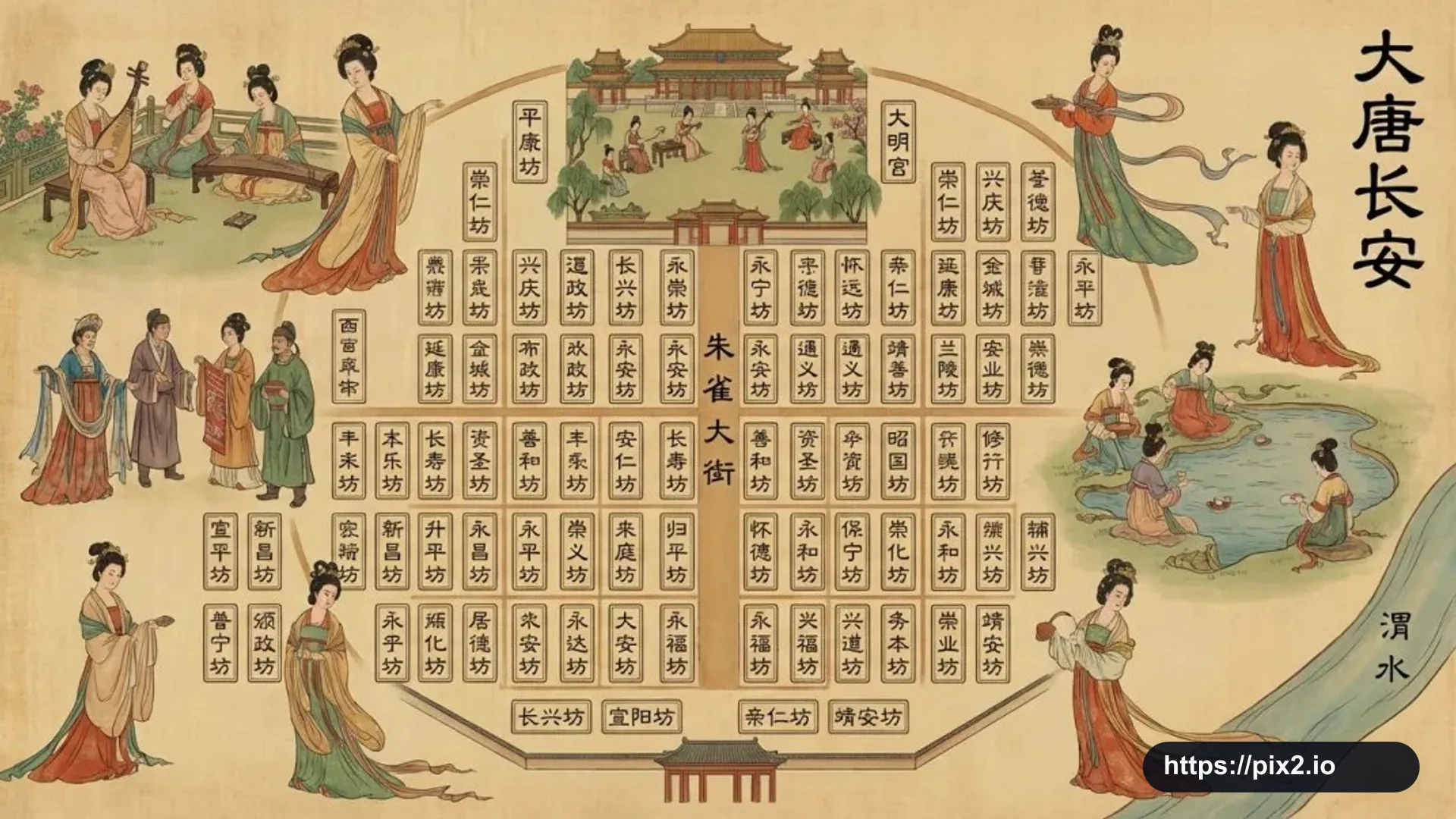
Create a 16:9 breathtaking illustrated cartography masterpiece showing a map of Changan, the Tang dynasty capital, rendered in the refined style of Tang court-lady painting on aged delicate silk with gongbi heavy-color technique. Use a long-scroll composition with scattered perspective so the city feels like a vivid woven tapestry rather than a rigid blueprint. Make Suzaku Avenue the central axis. Turn key landmarks into tiny narrative scenes: Daming Palace with court ladies playing instruments in a garden, the Western Market with Sogdian merchants trading silk with noblewomen, and Qujiang Pond with women enjoying a flowing-cup poetry gathering. Use elegant Tang court ladies as decorative map elements, with poses and sleeve ribbons guiding the viewer through the layout. Represent the 108 wards as graceful hand-drawn rectangular seals filled with plausible, historically styled, non-repeating two-character ward names ending in Fang, inspired by examples such as Pingkang Fang, Chongren Fang, Xingqing Fang, Daozheng Fang, Changxing Fang, Yongchong Fang, Qinren Fang, Yongning Fang, Huaiyuan Fang, Yankang Fang, Jincheng Fang, and Buzheng Fang. Render all ward-seal text in beautiful thin elegant small-seal-style Chinese characters. Add the main title Da Tang Changan vertically in powerful clerical script in the upper right. Label Suzaku Avenue and the Wei River directly on the silk background in graceful running script that follows the path curves. Use a rich Tang palette of cinnabar, malachite green, azurite blue, and gold leaf, with fine flowing linework, prosperity, poetry, and elegance. Avoid English, Roman letters, modern map styling, gridlike digital layout, Western art style, cartoon simplification, blank minimalism, watermarks, messy calligraphy, gibberish text, and low-resolution artifacts.


 16:9 ・ 4K