Replaceable fields
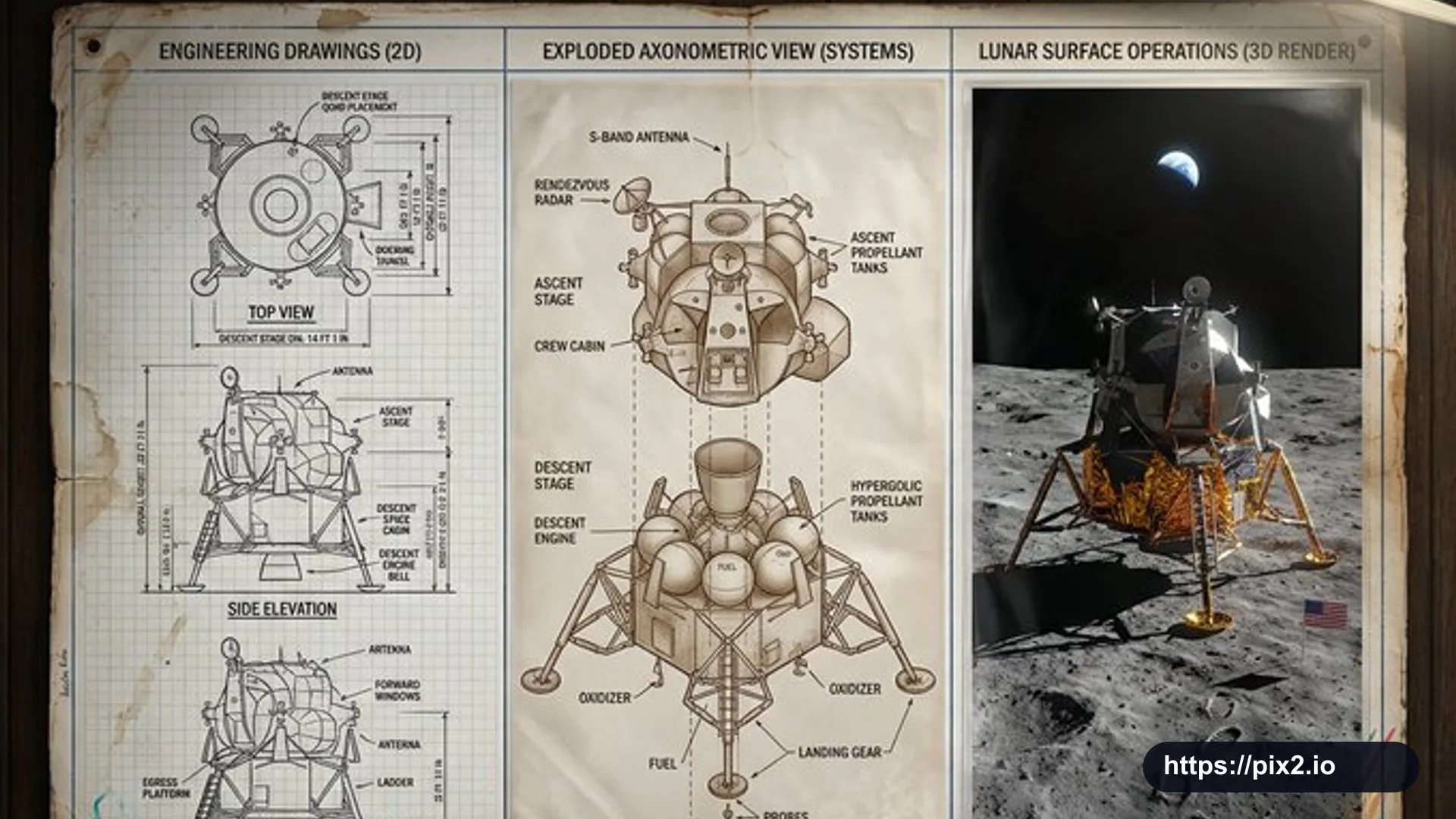
[Discipline]aerospace engineering[Subject]original lunar landing module[Iconic Features / Era]late-1960s modular spacecraft design[Key Internal Components / Materials]fuel tanks, crew cabin, landing gear, antenna systems[Iconic Environment / Scene]lunar surface operations[Lighting / Atmosphere / Motion Details]hard low-angle sunlight, long shadows, dust glow[Technical / Archival Tones]aged blueprint paper and monochrome ink[Emotional / Atmospheric Color Palette]deep space blacks, moon-gray dust, warm gold highlights[Title]Lunar Field Module[Year / Variant / Tagline]1969 / mission-ready variant / surface operations
Create a 16:9 museum-grade industrial design presentation board by an expert [Discipline] designer for [Subject] — [Iconic Features / Era]. Use a clean three-panel grid. On the left, show black-and-white 2D technical drawings with annotations, dimension lines, callouts, side and top views, and precise archival linework. In the center, show an exploded axonometric diagram revealing [Key Internal Components / Materials], with clearly separated parts, leader lines, and material notes. On the right, show a photorealistic 3D render of [Subject] in [Iconic Environment / Scene], with [Lighting / Atmosphere / Motion Details]. Let the visual style transition from [Technical / Archival Tones] on the drawing side to [Emotional / Atmospheric Color Palette] on the render side. Use a disciplined museum-style industrial design layout, subtle paper texture, ultra-detailed cinematic realism, and a title block reading "[Title] — [Year / Variant / Tagline]". Keep any text clean and generic. Avoid brand logos, real product copying, protected agency marks, cluttered layout, broken perspective, unreadable microtext, watermarks, and low-resolution artifacts.

 16:9 ・ 4K