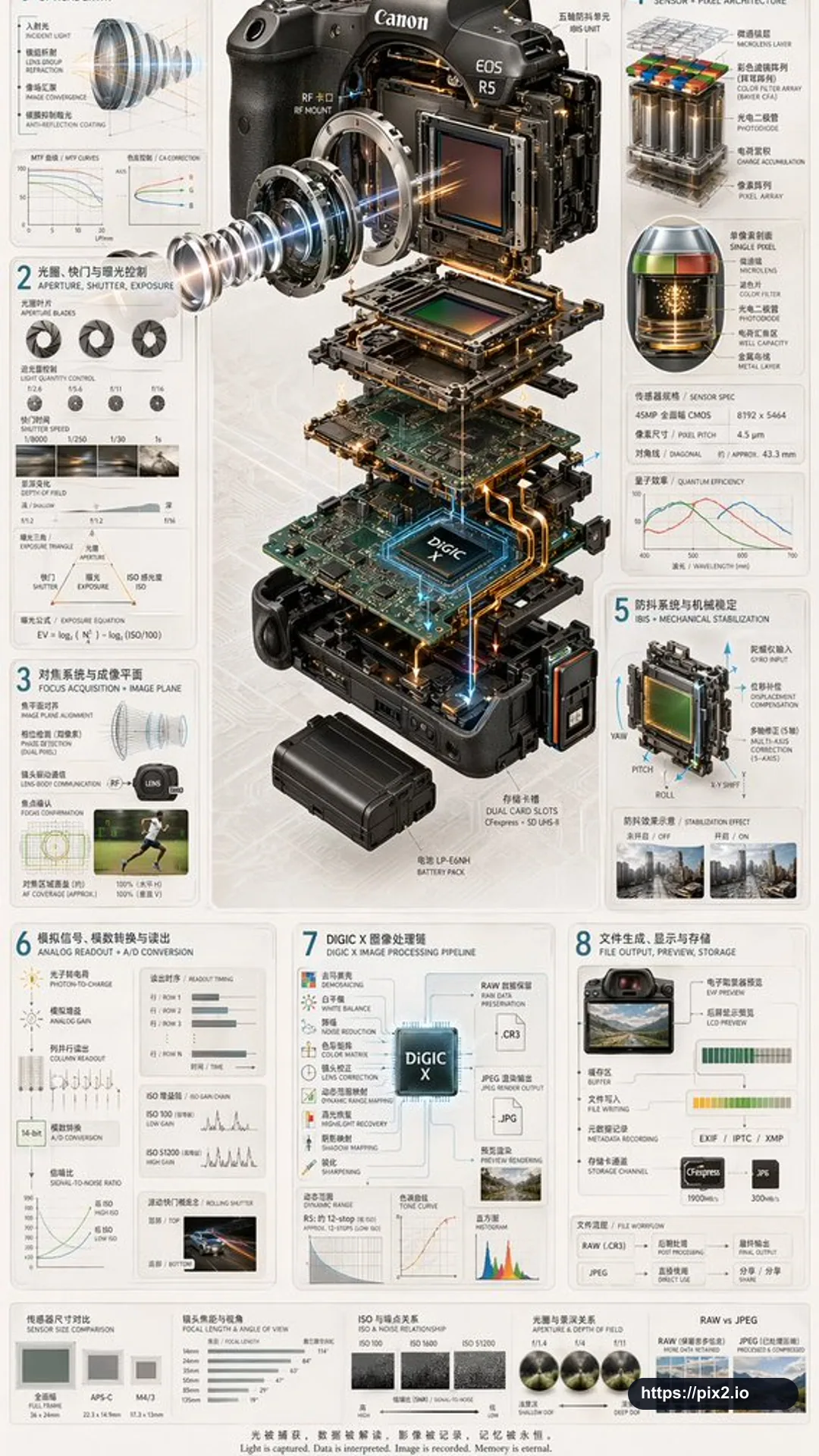
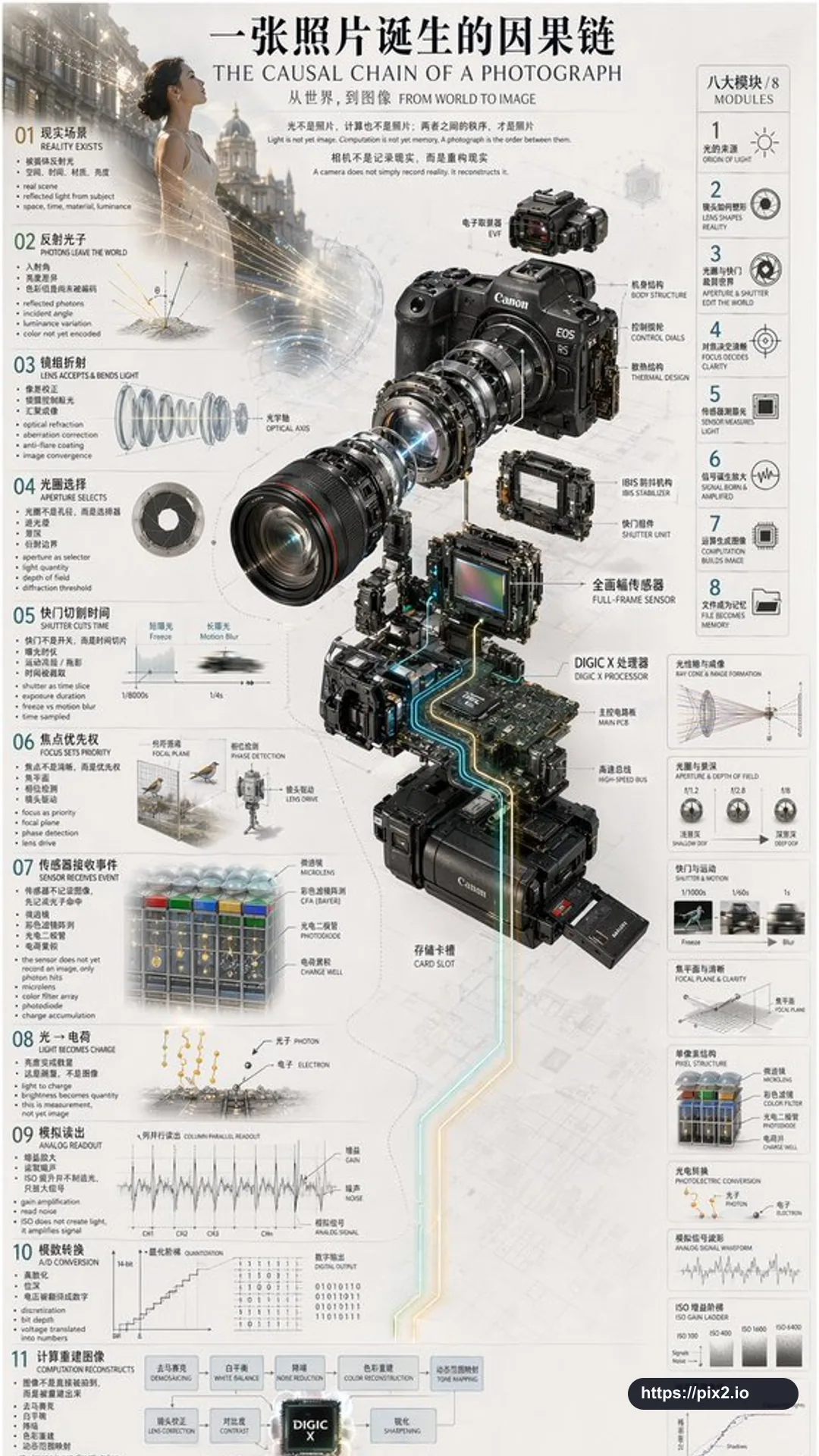
Create a vertical 9:16 technical infographic about [Subject Matter], titled [Main Title], with the subtitle “From World to Image.” Use a clean bilingual Chinese-English editorial layout, precise technical hierarchy, photorealistic camera components, wireframe overlays, thin annotation lines, glowing data paths, and crisp typography. The centerpiece is an exploded isometric view of [Camera Model], showing lens barrel, aperture blades, shutter unit, full-frame sensor, stabilization unit, processor module labeled [Processor Name], main circuit board, high-speed data bus, card slot, body shell, control dials, thermal design, EVF, and optical axis. On the left, create a chronological causal chain with 13 numbered steps: reality exists, photons leave the world, lens accepts and bends light, aperture selects, shutter cuts time, focus sets priority, sensor receives the event, light becomes charge, analog readout, A/D conversion, computation reconstructs, image appears, and memory outlives the moment. On the right, create an “8 modules” column explaining origin of light, lens shaping reality, aperture and shutter editing the world, focus deciding clarity, sensor measuring light, signal birth and amplification, computation building the image, and file becoming memory. Add seven side diagrams: ray cone and image formation, aperture and depth of field, shutter and motion, focal plane and clarity, pixel structure, photoelectric conversion, and analog signal waveform. Add a footer with five concise philosophical summary points about how the world becomes an image. The visual tone should feel technical, precise, bright, modern, slightly futuristic, and premium, with white space, fine gray lines, pale cyan/yellow data glow, and detailed but readable labels. Avoid real brand logos or copied product marks, extra watermarks, unreadable microtext, inaccurate optical physics, incorrect camera part placement, distorted hardware, cluttered hierarchy, cropped title, and low-resolution artifacts.

 9:16 ・ 4K