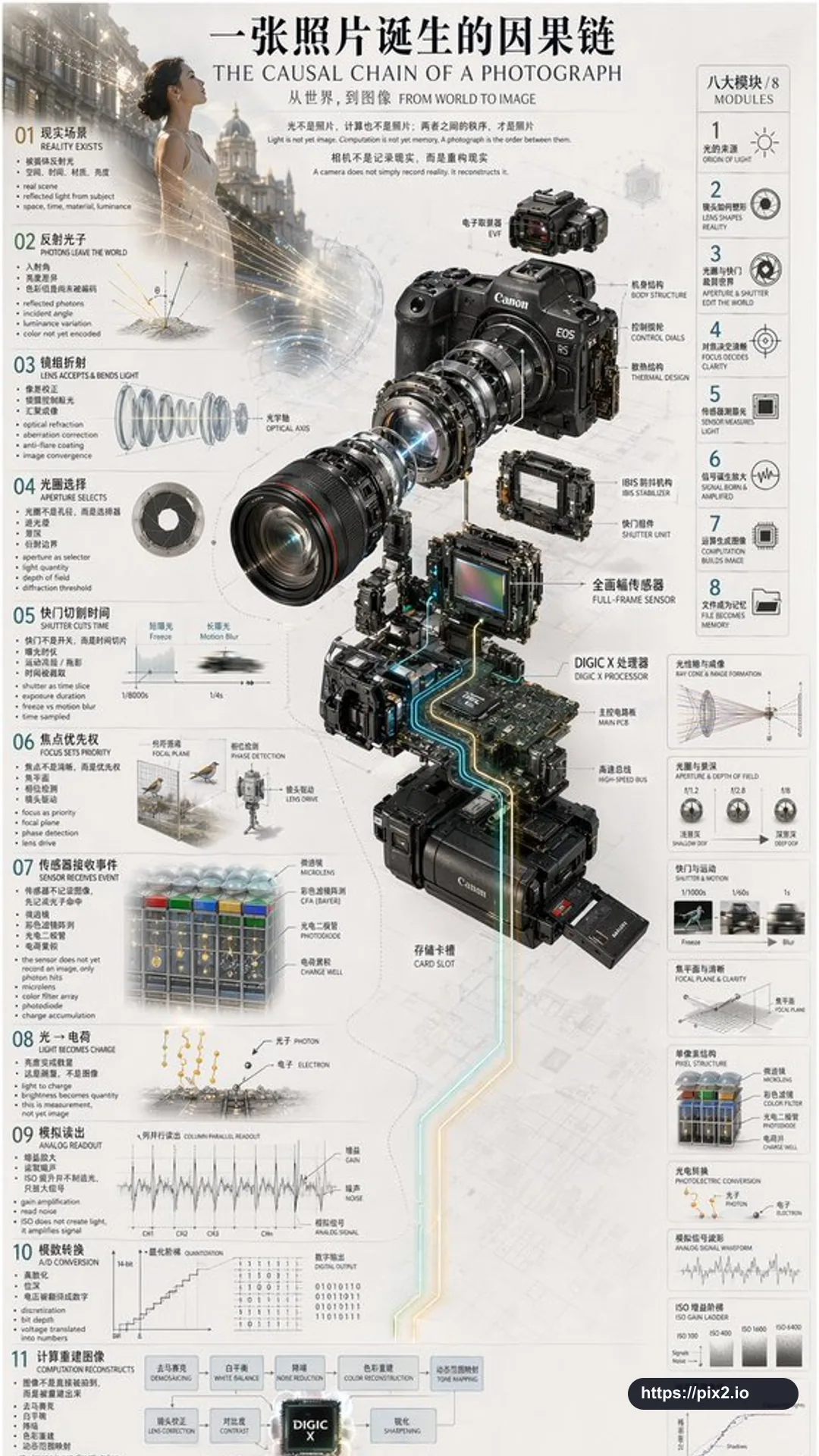
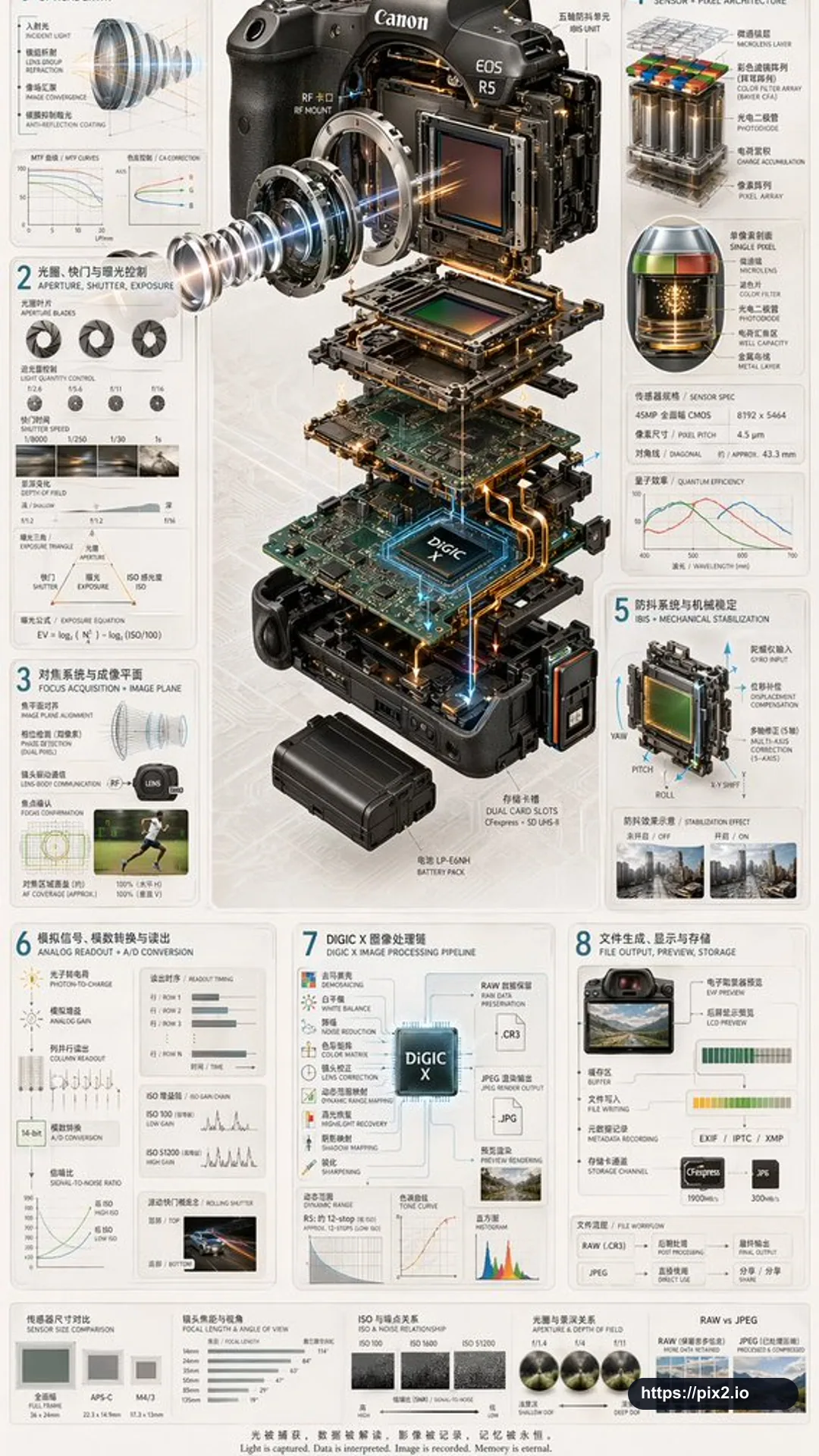
Create a vertical 9:16 technical infographic and exploded-view atlas titled [Main Title]. Use the subtitle “How an image is actually formed,” plus secondary lines “From photons to files” and “A camera is not a shell, but a computational chain.” The top area includes a key-specifications box with six concise bullet points and two small front/back body-view thumbnails, but all product naming must stay brand-neutral. The centerpiece is a highly detailed 3D exploded view of [Camera Model], with internal components separated vertically: lens mount, lens elements with glowing blue light rays, image sensor, motherboard with a glowing [Processor Name] chip, battery pack, dual card slots, EVF, body shell, and data pathways. Arrange eight numbered technical sections around the center: 1 optical entry with lens cross-section and line graphs; 2 aperture, shutter, and exposure control with aperture blade diagrams, shutter speed examples, depth-of-field diagram, and exposure triangle; 3 focus acquisition and image plane with lens alignment diagram and AF coverage example; 4 sensor and pixel architecture with 3D pixel array, single-pixel cross-section, sensor spec table, and quantum efficiency graph; 5 IBIS and mechanical stabilization with yaw, pitch, and roll axes plus comparison images; 6 analog readout and A/D conversion with signal flowchart, readout timing graphs, signal-to-noise graph, and rolling-shutter example; 7 image processing pipeline with central chip, dynamic range graph, tone curve, histogram, demosaicing, white balance, noise reduction, color matrix, lens correction, highlight recovery, shadow mapping, and sharpening; 8 file output, preview, and storage with file workflow, preview screen, storage-card icons, metadata fields, and RAW-versus-JPEG path. Add bottom comparison panels for sensor size, focal length and angle of view, ISO and noise relationship, aperture and depth of field, and RAW vs JPEG. Place [Footer Quote] as the final poetic footer. Style: clean, technical, premium, highly detailed, photorealistic components, blueprint annotations, light gray background, precise bilingual Chinese-English typography, fine dividers, and subtle cyan/yellow data glow. Avoid real brand logos, copied product marks, extra watermarks, misleading exact specifications, unreadable microtext, inaccurate optics, impossible exploded hardware, cluttered hierarchy, cropped title, and low-resolution artifacts.

 9:16 ・ 4K