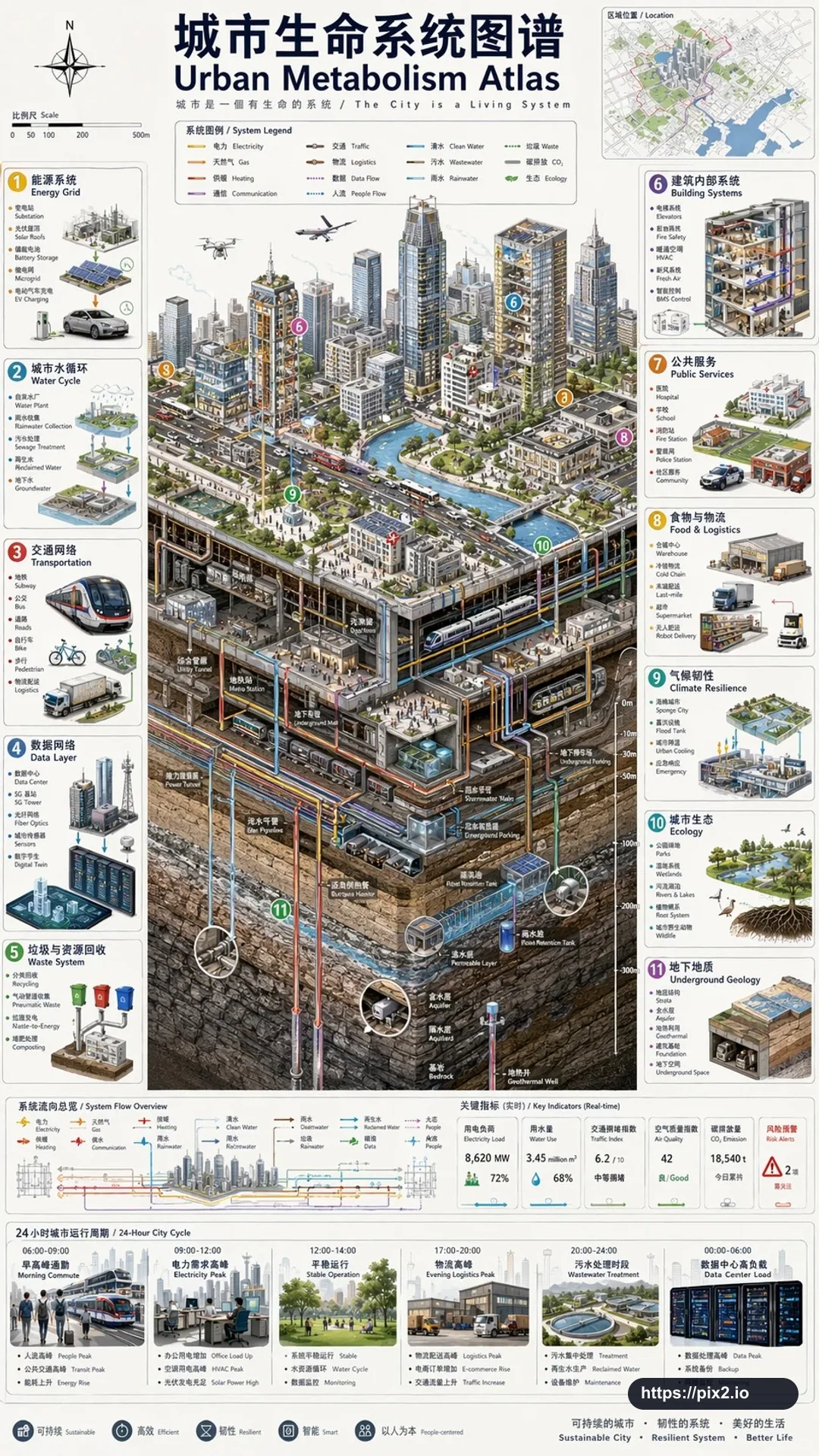
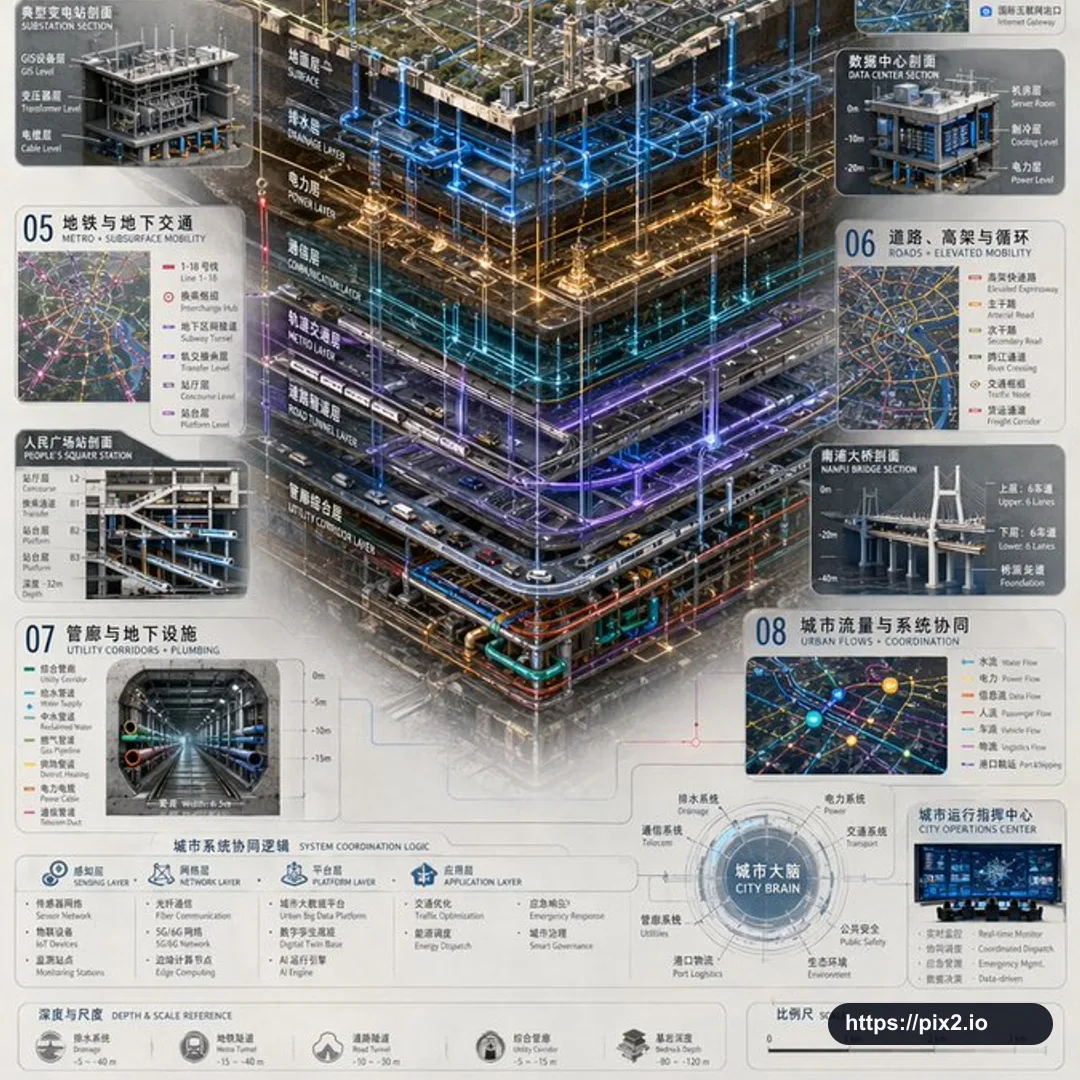
Create a square 1:1 complex urban systems atlas infographic for [Chinese City Name] / [English City Name]. Use [Color Palette], highly detailed technical illustration, and a 3D isometric cutaway style. Header title: “[Chinese City Name] 城市系统剖面 [English City Name] URBAN SYSTEMS ATLAS.” Add subtitles: “地表之上,是城市;地表之下,是秩序” plus [English Subtitle], and “一座城市如何运转 / How a Megacity Actually Works.” Top left: compass rose and city map labeled “[Chinese City Name] 市域位置 / [English City Name] Location.” Top right: “城市数据 / City Data” table with seven statistic rows. Centerpiece: [Centerpiece Style] of a megacity river landscape, showing stacked infrastructure layers: surface, drainage layer, power layer, communication layer, metro layer, road tunnel layer, and utility corridor layer. Arrange eight side panels: 01 urban skeleton map with eight legend items; 02 drainage and stormwater cross-section with five legend items; 03 power grid and energy distribution with substation cross-section and six legend items; 04 telecom and internet backbone with data-center cross-section and six legend items; 05 metro and subsurface mobility with a major station cross-section and six legend items; 06 roads and elevated mobility with bridge cross-section and six legend items; 07 utility corridors and plumbing with utility corridor cross-section and eight legend items; 08 urban flows and coordination with city operations center map and six legend items. Along the bottom, create system coordination logic with four steps: sensing layer, network layer, platform layer, and application layer; add a “City Brain” radial node diagram with one central node and eight peripheral nodes; include depth-scale and map-scale references. The design should feel like a premium data-rich civic infrastructure atlas: dense but organized, luminous, precise, layered, and readable. Avoid real corporate logos, extra watermarks, false city statistics, inaccurate landmark names, broken Chinese or English text, unreadable labels, inconsistent layer order, impossible infrastructure geometry, cluttered legends, cropped header, and low-resolution artifacts.

 1:1 ・ 4K